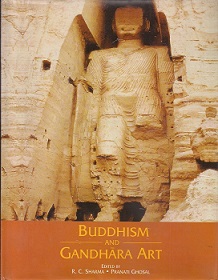
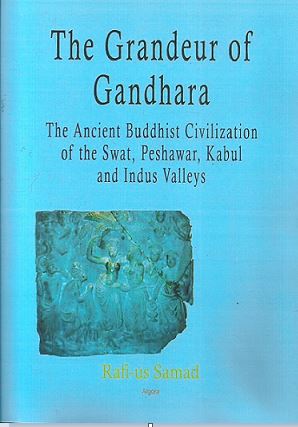
The Grandeur of Gandhara
The Ancient Buddhist Civilization of the Swat
Peshawar, Kabul and Indus Valleys
The aching desolation we see in Pakistan and Afghanistan today masks the historical reality: this region once formed the heart of a highly developed civilization whose cultural impact was felt from China to Persia.
Known as Gandhara, it was a major center of Buddhism, and its cultural attainments were highlights of ancient civilization. Persian, Greek and Central Asian invasions actually promoted the development of a multi-cultural, multi-ethnic society in this region of the South Asian sub-continent.
Hundreds of thousands of beautiful stone sculptures belonging to the Gandhara Civilization were recovered through excavations in Afghanistan and Pakistan in the late-19th century. Renowned archaeologists carried out excavations at various sites, and the author has gathered further information through extended visits to numerous archaeological sites associated with the lost Gandhara Civilization including those in the Taxila, Peshawar, Charsadda, Mardan and Swat regions in Pakistan, and study of the large number of artifacts from these sites which are on display in museums.
Rafi-us Samad’s research, accompanied by some 60 illustrations, offers Americans an entirely new understanding. This research reveals a great deal of continuity in the socio-cultural development of the region, which is referred to in this book as Greater Gandhara, from the time it became a part of the Achaemenid Empire in the 6th century BCE till the end of Kidara Kushan?s rule in the 5th century CE. Further, it reveals that after the Achaemenids had established the physical and administrative infrastructure in Greater Gandhara, the continuity in socio-cultural development in the region was maintained mainly by the growing Buddhist population.
The ancient people of the Gandhara region exhibited a spirit of independence that prevailed despite many challenges. Following the invasion of Alexander the Great, his successors had no difficulty in colonizing the neighboring areas of Bactria (Northern Afghanistan) and Sogdia (Uzbekistan), but they could not do the same in Gandhara. Similarly the Scythians, Parthians and the Kushans ruled over the Central Asian region as colonizers, but not so in Gandhara. Here they ruled not over the people, but with the people. Their administration was highly de-centralized, with the locals playing a major role in the regional administration and having a major say in the social and cultural affairs of the entire population.
Finally, the book highlights the interactive environment which prevailed in Gandhara throughout the transient and mature phases of the Gandhara Civilization: Alexander’s companions hobnobbing with the naked fakirs of Taxila; Menander, the great Indus-Greek ruler, finding time to engage in prolonged question-and-answer sessions with Buddhist scholars at the monastery near Sagala (Sialkot); and the greatest of the Kushan conquerors, Kanishka, finding pleasure in the company of local intellectuals and artists such as Asvaghosha and Vasumitra, and presiding over the official launch of Mahayana Buddhism.
Thus, in the northwestern regions of today’s Pakistan and southeastern regions of Afghanistan, a unique civilization arose. Many different races contributed and many cultures merged to bring about a major sociological change and establish a distinct cultural identity.
My Rating
You Have To Buy The Product To Give A Review
All Ratings
Related Books